




Smart Park UI Solution: A New Paradigm of Digital Management Empowered by Technology
In today's era of accelerating penetration of the digital economy, parks, as core carriers of industrial agglomeration, are undergoing a crucial transformation in their management models from traditional manual operation and maintenance to intelligent digitalization. The Smart Park UI Solution, with "technology empowering industry" as its core orientation, focuses on the core pain points of park management. Through data integration, visual presentation and interaction optimization, it breaks down information barriers and data silos, taps into the potential value of data, and provides park managers with comprehensive, accurate and efficient management tools, helping to usher in a new era of digital park management. Xiyue Design provides professional and reliable design service support for the digital transformation of parks.
I. Core Existing Pain Points in Park Management: The "Obstacles" to Digital Transformation
Currently, park management faces multiple challenges at the UI/UE level, which directly restrict management efficiency and the release of digital value. These issues can be summarized into four core pain points:
1. Untapped Data Value and Low Resource Utilization Rate
Most park management data is collected scattered from various systems, lacking unified integration and secondary processing, resulting in rough data forms and vague value. Dispersed data sources cannot form effective linkage, leading to "data hibernation", which makes it difficult to support scientific decision-making and greatly reduces data value.
2. High Information Barriers and Weak Collaborative Efficiency
Most hardware equipment in parks is purchased from different manufacturers, with inconsistent data standards, and varying collection frequencies and methods, leading to difficulties in data sharing. There is a lot of information impurities and blocked circulation, forming "data chimneys". The poor synergy between various systems significantly increases management costs.
3. Limited Perspective Experience and Insufficient Display Dimensions
Traditional park interfaces are mostly presented in the form of 2D floor plans or simple 3D schematic diagrams, with fixed perspectives that cannot be rotated, and it is even impossible to view details inside buildings from a micro perspective. Limited perspectives directly lead to one-sided display content, making it difficult for managers to grasp the panoramic information of the park.
4. Poor Visual Interaction and Room for Improvement in User Experience
The interface design has problems such as insufficient aesthetics, uncoordinated color matching, and chaotic layout. Moreover, it lacks accurate 3D model support, making it impossible to intuitively present the entire view of the park. At the same time, interaction problems such as compatibility between large screens and keyboard/mouse operations, touch screen interaction optimization, and early warning information display further affect user operation experience and work efficiency.
II. Core Value of the Solution: From "Data Presentation" to "Value Creation"
Xiyue Design's Smart Park UI Solution is not a simple interface optimization, but takes "data integration + scenario adaptation + experience upgrading" as the core to achieve a leap from "data presentation" to "value creation". Its core value is reflected in four dimensions:
1. Activate Data Value and Improve Management Accuracy
By summarizing, cleaning and refining data from multiple systems, scattered and trivial data is transformed into usable and efficient value data, presented in an accurate and intuitive way, helping managers fully grasp park information and improve their perception of park operation status.
2. Innovate Visual Experience and Realize Panoramic Management
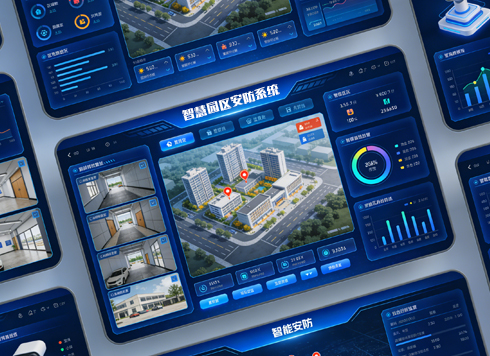
Integrating data dashboards, rolling display and 3D modeling technology, it breaks the limitations of traditional perspectives and realizes all-round, dead-angle-free visual presentation of the park. At the same time, combined with digital twin technology, managers can control the overall situation of the park without leaving their offices.
3. Optimize Interaction Logic and Improve Operational Efficiency
Taking user needs as the core, it reconstructs interaction rules and information architecture to solve practical problems such as compatibility between large screens and keyboard/mouse, and touch screen optimization. Through accurate display of early warning information and convenient operation processes, the efficiency of park management is greatly improved.
4. Strengthen Brand Perception and Enhance User Stickiness
Create an interface with both a sense of technology and aesthetics with advanced visual language, and combine personalized data display methods to meet the aesthetic needs and business scenarios of different users, enhancing users' recognition and loyalty to the product.
III. Core Highlights of the Solution: Dual Breakthroughs in Technology and Experience
01 Ten Years of Accumulation, Full-Process Closed-Loop Design Services
Relying on more than ten years of professional design experience, Xiyue Design has formed a full-process service system covering "demand mining - architecture sorting - prototype design - specification output". Through industry research, user interviews and other methods to deeply mine needs, combined with advanced design methodologies, optimize product architecture and operation processes, output standardized design specifications, and ensure that the solution is implementable and easy to reuse. For issues such as irregular shape design and multi-resolution adaptation, exclusive solutions are provided to ensure development efficiency and design consistency.
02 Multi-Technology Support, High-Quality 3D Park Modeling
It supports mainstream modeling tools such as C4D, 3Dmax, Unity3D, and combines Three.js development technology to achieve 1:1 high-precision restoration of the park. Through interactive methods such as dragging and roaming, it can freely switch between the park's panoramic view and the internal perspective of buildings, and electronic labels accurately identify location and building information to avoid "spatial disorientation". It also supports switching between model wireframe/solid modes to meet the needs of different scenarios such as structure viewing and daily management.
03 In-Depth Data Mining, Full-Dimensional Information Presentation
Integrate multi-dimensional data such as park water and electricity energy consumption, ecological environment, space utilization, task planning, visitor management, and early warning and alarm. Through data cleaning and correlation analysis, tap into potential value information. Highlight core data in the form of visual charts and dynamic indicators, allowing managers to easily obtain key information and provide a reliable basis for decision-making.
04 Digital Twin Technology, Refined Park Management
Build a virtual twin of the park to realize real-time linkage between the physical park and the virtual space. Introduce a weather system to simulate natural scenes such as day and night, rain and snow, making the virtual park closer to the actual operation status. When equipment failures, safety warnings and other situations occur, early warning information can be synchronized to the corresponding position of the 3D model in real time, realizing a rapid closed loop of "problem location - disposal - feedback".
05 Scenario-Based Architecture Reorganization, Improve Information Transmission Efficiency
Combined with the core scenarios of park management, reconstruct the information layout based on the "visual hot zone" theory, place key data and operation entrances in the visual focus position, streamline redundant information, and achieve "clear primary and secondary, prominent key points". At the same time, follow the human eye reading movement line, optimize the information arrangement order, allowing users to obtain the required content in the shortest time and improve information transmission efficiency.
06 Diverse Display Methods, Adapt to Personalized Needs
Provide various display forms such as data cockpit, data dashboard, and command large screen, and customize exclusive data presentation solutions according to users' business focus and usage scenarios. For issues such as information density control and rolling logic for large screen display, technologies such as dynamic loading and layered display are used to balance information integrity and visual comfort, meeting the usage needs in different scenarios.
IV. Conclusion: Empowering the New Development of Smart Parks with Design
The core of a smart park is "people-oriented", and the UI solution is the key bridge connecting people and park data. Xiyue Design, with technology as the cornerstone and experience as the core, breaks the barriers of traditional park management through data integration, visual innovation and interaction optimization, making digital management more efficient, accurate and convenient. In the future, we will continue to deepen our involvement in the smart park field, combine cutting-edge technologies with industry needs, and provide more valuable design solutions for the digital transformation of more parks.