


UI Design Solutions for the Intelligent Manufacturing Industry
As a pillar industry of the national economy, manufacturing is the core benchmark for measuring a country's scientific and technological strength and innovation capability. Driven by the wave of Industry 4.0, intelligent manufacturing (IM) has become the core direction of industrial upgrading, covering key fields such as chip semiconductors, intelligent production, and autonomous driving, involving complex production processes, diverse equipment types, and massive business data. In this context, software interfaces are no longer simple operation carriers, but have become the core hub connecting people, equipment, and data. With over a decade of deep cultivation in the intelligent manufacturing field, Xiyue Design has created a UI design solution tailored for the software of a new generation of intelligent equipment. Through intuitive visual presentation, efficient interaction logic, and consistent operational experience, it empowers core software such as semiconductor etching software, Manufacturing Execution System (MES), and intelligent manufacturing cloud platforms, helping enterprises achieve a leapfrog development from informatization to digitalization and then to intellectualization.
I. Core Pain Points of UI Design in the Intelligent Manufacturing Industry
Due to the particularity of intelligent manufacturing scenarios, traditional UI design often fails to adapt to industry needs, and many problems directly restrict production efficiency and management effectiveness, which can be summarized into five core pain points:
(1) Chaotic Interface Layout and Inefficient Information Acquisition
Most traditional industrial software, limited by the era of development, is filled with excessive pop-ups, hierarchical menus, and redundant options, with core functions obscured by complex elements. In emergency production scenarios, operators need to spend a lot of time locating function entrances, which not only reduces work efficiency but also may trigger production risks due to operational delays.
(2) Lack of Design Consistency and High Learning Costs
The interface styles and operation logic of different functional modules within the same system vary significantly. For example, the button positions and interaction methods of the equipment monitoring module and the data statistics module are completely independent. This forces operators to repeatedly adapt to the usage rules of different modules, which not only increases the training cycle for new employees but also raises the probability of misoperations. Especially in high-precision production scenarios such as semiconductors, minor misoperations may cause huge losses.
(3) Irrational Interaction Logic and Heavy Operational Burden
Problems such as cumbersome operation processes, excessive repetitive steps, and ambiguous data input guidelines are widespread. For instance, in some MES systems, completing the issuance of a production task requires jumping through 8 levels of menus, and there is a lack of quick access to commonly used operations; there are no clear format requirements in the data entry link, often leading to process rework due to input errors.
(4) Improper Visual Expression and Weakened Core Information
The interface style is outdated, the color matching is messy, and the visual weight of key functions and secondary information is the same. For example, critical data such as equipment operating status and production progress adopt the same visual style as non-urgent information such as system announcements and historical records, making it impossible for users to quickly capture core operation information and reducing the speed of decision-making responses.
(5) Difficult Later Reuse and Insufficient Cross-Scenario Adaptation
The design results lack a standardized system, and the completed components and styles cannot be quickly reused in other product lines; in the face of different device resolutions and screen sizes, interface deformation and function misalignment are prone to occur; at the same time, the characteristic limitations of development frameworks such as WPF and WinForm are not fully considered, leading to a disconnect between design solutions and development implementation.
II. Core Value of the Solution: Full-Dimensional Upgrade from Efficiency to Experience
In response to industry pain points, this solution takes "user-centric and business-oriented" as the core, and achieves four core value improvements through visual optimization, interaction reconstruction, and systematic design, creating practical benefits for enterprises:
(1) Empowerment through Data Visualization to Support Scientific Decision-Making
Massive and complex data in the production process, such as equipment parameters, production capacity data, and quality indicators, are converted into intuitive visual charts such as bar charts, line charts, and heat maps, combined with a real-time dynamic update mechanism, helping managers quickly identify key issues such as production bottlenecks and equipment abnormalities. At the same time, customized data reports are generated to provide accurate data support for decisions such as production scheduling and process optimization.
(2) Process Optimization and Reconstruction to Improve Production Efficiency
In-depth research is conducted on the entire manufacturing production process and management logic, and redundant operations are streamlined and merged. For example, the multi-step process of "task issuance - progress tracking - quality feedback" is optimized into an integrated operation interface; through shortcut key settings, pinning of commonly used functions and other designs, repetitive operations are reduced, and the average operation time can be reduced by more than 30%, significantly improving production and management efficiency.
(3) Experience Upgrade and Cost Reduction to Lower Usage Thresholds
With a concise and unified interface style, clear and definite operation guidelines, and timely and accurate feedback mechanisms, the learning cost for users is reduced. For example, through new employee guidance animations, operation prompt pop-ups and other designs, new employees can quickly master the use of core functions; operation results are fed back in real time through a combination of colors, icons and text, avoiding the risk of misoperations and improving user satisfaction.
(4) Cross-Scenario Adaptation to Ensure Application Stability
Fully considering the differences in different operating systems (Windows, Linux), screen sizes (industrial control computers, tablets, data large screens) and resolutions in intelligent manufacturing scenarios, a responsive design and component-based development approach are adopted to ensure that the software maintains consistent visual effects and operational experience in multiple scenarios such as etching equipment, production workshop large screens, and mobile inspection terminals, guaranteeing the continuity of the production process.
III. Core Highlights of the Solution: Dual Empowerment of Technology and Experience
Relying on more than ten years of industry accumulation and hundreds of project practices, this solution has formed eight core highlights, building a full-link service capability from design to implementation:
01 A Decade of Industry Accumulation and Full-Process Interaction Reconstruction
Integrating leading domestic and foreign design methodologies, a complete service process of "user research - demand disassembly - architecture sorting - prototype design - implementation verification" is established. For different sub-sectors such as semiconductors and automobile manufacturing, customized user interview outlines and business scenario analysis frameworks are designed to deeply explore the core needs of operators. By reconstructing product architecture, optimizing interaction rules, and drawing full-process page interaction prototypes, redundant task steps are merged. For example, the process of "parameter setting - process start - status monitoring" of semiconductor etching software is integrated into a single-page operation, greatly improving work efficiency.
02 Boundless Integrated Design to Empower Industrial Upgrading
Closely following the development trend of the deep integration of intelligent manufacturing with the Internet, big data, and the Internet of Things (IoT), the closed design concept of traditional industrial software is broken. Digital transformation thinking is integrated into UI design, and modular design is used to realize the visual integration of multi-dimensional resources such as production equipment, human resources, and material information. For example, a cross-departmental data sharing interface is designed for the intelligent manufacturing cloud platform, supporting collaborative operations of multiple roles such as production workshops, R&D teams, and supply chains, helping enterprises build an open and collaborative industrial ecosystem and realize the transformation from large-scale standardized production to personalized customization.
03 Scenario-Based B-end Homepage to Focus on Core Value
Taking "user role + business scenario" as the core, the design logic of the B-end platform homepage is reconstructed. For different roles such as production managers, equipment maintenance personnel, and quality inspectors, core information is presented in a customized way: the manager's homepage highlights macro indicators such as overall production data and order progress; the maintenance personnel's homepage prioritizes displaying key information such as equipment operating status and fault warnings. At the same time, high-frequency operation functions (such as task assignment and data export) are set as quick access entries to shorten the operation path, avoid frequent switching between multiple modules for users, and make the homepage a "business command center".
04 3D Digital Twin to Achieve Panoramic Monitoring of Production Situation
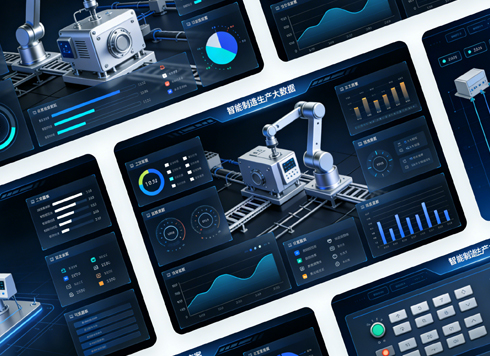
Adopting customized 3D scene rendering technology, the factory layout, production line structure, equipment appearance and operating status are accurately projected to the software interface in the form of digital twins. Through real-time data synchronization, 1:1 simulation of the physical production process by the virtual scene is realized, providing real-time monitoring capabilities in scenarios such as fault early warning, material management, and production progress tracking. It supports free movement of perspectives and quick switching of scenes, and operators can observe from the macro factory area to the micro equipment from multiple dimensions. For example, clicking on the 3D equipment model can view detailed operating parameters, greatly improving the accuracy and efficiency of management.
05 2.5D Graphic Visualization to Clearly Present Process Context
For scenarios such as industrial pipelines and configuration control, 2.5D graphic drawing technology is adopted to clearly display the distribution of process flows and the material flow direction and energy transfer path of each sub-link. Through visual elements such as equipment icons and color changes (e.g., green for normal operation, red for abnormal), operators can quickly locate problem nodes. Compared with traditional 2D interfaces, 2.5D design has both spatial layering and operational convenience, and can create dynamic visual presentations such as equipment start-stop animations and material flow effects, improving the attractiveness of the interface and the efficiency of information transmission.
06 Establishing UI Design Specifications to Ensure Global Consistency
Aiming at the characteristics of large industrial software with multiple modules and product lines, a complete UI design specification system is formulated. Typical pages in various business scenarios (such as list query, data statistics, and form entry) are sorted out, and design standards for basic components (buttons, input boxes, drop-down menus) and business components (equipment status cards, production progress bars) are clarified to ensure that similar functions adopt unified operation methods and layout styles. For example, it is stipulated that the "confirm" button of all modules is uniformly located at the bottom right corner of the interface with an error of no more than 2px, maximizing the experience consistency of different product lines and reducing the learning cost of cross-product use.
07 In-Depth Application of WPF Technology to Meet Personalized Needs
Relying on rich development experience, seamless connection between UI design and development frameworks such as WPF and WinForm is realized. Taking full advantage of the powerful functions and high customizability of WPF controls, it can not only efficiently reuse built-in basic controls such as buttons and data grids, but also develop customized controls according to business needs. For example, a special parameter adjustment slider is designed for semiconductor etching software, supporting precise numerical input and visual adjustment. Through control encapsulation technology, mature design components can be quickly reused in different product lines, and the problem of multi-resolution adaptation is solved at the same time, ensuring the efficiency and quality of development and implementation. In cooperation projects with NAURA Technology Group, Chengdu Institute of Optics and Electronics, etc., full-process services from UI design to software development and testing have been completed.
08 Data Large Screen Visualization to Empower Intelligent Decision-Making
Focusing on the construction needs of intelligent manufacturing data middle platforms, a professional large screen UI design solution is created. Following the principle of "clear information hierarchy and prominent data focus", through reasonable layout partitioning (such as core indicator area, trend analysis area, abnormal warning area) and combining color psychology to design a data expression system (such as red for warning, yellow for reminder, green for normal), decision-makers can quickly capture key information. It supports real-time data refresh and drill-down analysis; clicking on an indicator on the large screen can drill down to view detailed data; at the same time, exquisite icons and dynamic chart designs are adopted to balance the professionalism and visual beauty of data display, realizing the visual implementation of "data-driven decision-making".
IV. Implementation Capability and Cooperation Value
Xiyue Design not only provides professional UI design services, but also has full-link implementation capabilities from design to development. In cooperation with leading industry enterprises such as NAURA Technology Group and Chengdu Institute of Optics and Electronics, it has completed the integrated delivery of "design - development - testing" for multiple projects such as semiconductor etching software and optical inspection equipment control systems, ensuring the accurate implementation of design solutions. Our core advantage lies in: understanding both the business logic of the intelligent manufacturing industry and proficient in UI design and development technologies, which can effectively solve industry pain points such as "disconnection between design and business" and "difficult implementation of solutions".
V. Conclusion
At the critical stage of intelligent manufacturing moving towards high-quality development, UI design has become a core element to improve production efficiency, reduce operating costs, and ensure production safety. Xiyue Design's UI design solution for the intelligent manufacturing industry, based on more than ten years of industry experience and taking user needs as the core, provides enterprises with "good experience, easy implementation, and high value" UI design services through technological innovation and design optimization. In the future, we will continue to deepen our cultivation in the intelligent manufacturing field, keep up with the development trend of Industry 4.0, continuously iterate design methodologies, and help more manufacturing enterprises achieve digital transformation and intelligent upgrading.