



UI Design Solutions for the Healthcare Industry: Empowering through Design to Safeguard Health for Patients and Practitioners
The healthcare industry undertakes the noble mission of safeguarding lives. As the core carrier of interaction between medical products and users, UI/UE design is directly related to the improvement of medical staff's work efficiency and the optimization of patients' medical experience, and also plays a key role in ensuring diagnosis and treatment safety. Xiyue Design has deep roots in the medical field, with the mission of "Co-creating the future of healthcare and lighting up the light of hope for every life", and focuses on creating user-centric interface solutions for doctors and patients.
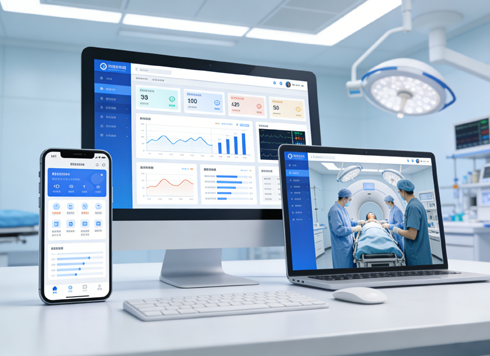
We strictly follow the usage norms and expression habits of the medical industry, construct concise and efficient operational logic through process optimization, integrate humanized innovative design concepts, and flexibly use creative techniques such as illustrations, 3D animation, and micro-interactions. This enables medical products to maintain professional rigor while providing a pleasant and easy-to-use experience. With solid industry accumulation and professional strength, Xiyue Design has successfully served well-known enterprises in various fields including orthopedic surgical robots, laparoscopic surgical robots, medical imaging diagnosis, health big data management, AI intelligent self-diagnosis, sample testing, and smart medical large screens, and delivered a series of benchmark projects.
1. In-depth Analysis of Core Pain Points in UI/UE Design for the Healthcare Industry
Due to the particularity and high standardization of medical scenarios, UI/UE design faces multiple complex challenges. These problems not only restrict the exertion of product use efficiency but also may hide potential risks to diagnosis and treatment safety, which can be summarized into the following four dimensions:
(1) Inefficient Interactive Experience: Cumbersome Processes and Lack of Guidance
Most medical software falls into the misunderstanding of "function stacking", lacking systematic sorting of operational logic, resulting in multiple redundant steps to complete a single task. The operation process of key functions is cumbersome, the guidance for human-computer interaction is not intuitive, which is prone to misoperation; the definition of clickable operation areas in touch screen interfaces is vague, further increasing the operation difficulty. For example, the functional hierarchy of the surgical robot control interface is chaotic, and medical staff need to spend extra time locating key buttons, which not only reduces work efficiency but also may affect the diagnosis and treatment process due to operation delays in emergency scenarios. At the same time, most medical products in hospitals need to be reused, but the complex operational logic is difficult to be quickly understood and remembered, increasing the user burden.
(2) Disordered Information Presentation: Overload and Rigid Expression
Medical products need to carry massive information such as patient medical records, examination data, and diagnosis results, with diverse data types including text, numerical values, and images. Traditional design often presents information in a dense listing manner, without scientific hierarchical classification and lacking diversified data visualization design. This makes it difficult for medical staff to quickly capture core data, and patients are even unable to understand professional information. This dual problem of "information overload" and "inefficient expression" seriously affects the timeliness and accuracy of diagnosis and treatment decisions.
(3) Inadequate System Collaboration: Fragmented Styles and Implementation Obstacles
At present, most medical equipment has the prominent problem of "disconnection between industrial design and UI design". The mechanical texture of hardware and the visual style of software are highly inconsistent in color, lines, and temperament, increasing users' cognitive burden from a psychological perspective. More critically, the connection between design and development is not smooth: the drag-and-drop function of touch interfaces is difficult to implement smoothly, the visual effects of design drawings cannot be fully restored due to the limitations of development frameworks such as QT/WPF, and the lack of unified UI specifications and component standards leads to extremely high costs for later maintenance and function iteration.
(4) Lack of Humanistic Care: Rigid Styles and Emotional Alienation
Most medical software focuses on function realization, ignoring humanized and emotional design, and the interfaces generally show "stiff and rigid" characteristics. Color selection is not well considered, neither reflecting the gentle attribute of the medical industry nor relieving the psychological pressure of doctors and patients; interactive feedback is weak and operation guidance is vague. Medical staff are prone to visual fatigue and psychological weariness when using them for a long time in high-intensity and fast-paced work, while patients will aggravate medical anxiety when facing cold interfaces, making it difficult to form emotional resonance.
2. Core Value of the Solution: Building a Three-Dimensional System of "Safety-Efficiency-Humanism"
The particularity of medical products determines that UI/UE design must break through the traditional cognition of "aesthetics first", deeply integrate "safety, efficiency, and humanism" to form a design value system with both professional attributes and emotional temperature, accurately responding to the core needs of the industry:
- Safety as the foundation, building a strong defense line for diagnosis and treatment: Integrate "error prevention" into the entire design process, reduce the risk of misoperation through clear operation guidance, clear feedback mechanisms, and fault-tolerant design. Especially in key scenarios such as surgical robots and imaging diagnosis, design such as functional permission grading and secondary confirmation of operations provides a solid guarantee for diagnosis and treatment safety, which is the primary criterion for medical design.
- Efficiency as the guideline, adapting to the medical rhythm: Take "minimal process" as the core goal, enable medical staff to "one-click access" key functions in emergency scenarios by cutting redundant operations, optimizing functional hierarchy, and reconstructing product architecture. Free users from complex operations, allowing them to devote more energy to patient diagnosis and treatment rather than equipment operation, adapting to the fast-paced work characteristics of the medical industry.
- Humanism as the soul, relieving the pressure of doctors and patients: Focus on emotional design, abandon "visual impact" in color selection, and adopt mild and soothing tones to make patients feel at ease and warm; design ergonomic interaction logic for medical staff to reduce operational fatigue. At the same time, highlight the integration of brand characteristics and hardware equipment, integrate international design language on the basis of rigor, adapt to the needs of multilingual interfaces, and achieve the dual value of "comfortable for medical staff and reassuring for patients".
- Innovation as the wing, leading the industry development: Innovation is the strong vitality of design. We break through traditional styles without sticking to one pattern, keep up with global design trends, and combine international design language with medical professional characteristics. Through the integration of technology and creativity, promote the upgrading of medical products from "usable" to "easy to use" and "lovable to use", assist the digital transformation of the medical industry, and inject new momentum into the development of medical cause.
Meanwhile, the design adheres to the "principle of moderation", rejects "over-design", and focuses on polishing details. Every design fits user needs and usage scenarios, achieving elegance and generosity, conforming to the aesthetic concepts of most target customers, and realizing the balance between function and aesthetics.
3. Core Highlights of the Solution: Full-Process Empowerment to Precisely Solve Industry Problems
Based on more than ten years of design experience in the medical industry, Xiyue Design has formed a full-process solution "from demand mining to implementation and operation and maintenance", with seven core highlights to precisely solve industry pain points and realize full-link value empowerment:
01 Ten Years of Accumulation, Building a Full-Process Interactive Design System
Relying on more than ten years of professional accumulation, we have built a complete medical design methodology and service process, and continuously optimize and upgrade by benchmarking international leading products. Through customized user interviews, focus group discussions and other methods, we deeply explore the core needs and usage habits of different roles such as medical staff, patients, and hospital managers. Reconstruct product architecture based on demand, adjust and optimize interaction rules, and build interaction specifications in line with industry characteristics. Finally, output full-process page interaction prototypes, significantly improve user satisfaction and work efficiency by merging redundant steps and simplifying operation paths. Relevant methodologies have been verified and implemented in many projects.
02 Technology Integration, Innovating the Experience of Smart Medical Large Screens
For smart medical large screen scenarios, we deeply integrate lightweight C4D technology and GIS roaming technology to realize 3D reconstruction of hospital building layout. The interface cleverly integrates macro indicators such as hospital scale, key disciplines, service quality, and human resources, as well as real-time registration and treatment data. Through multi-dimensional charts, dynamic visualization and other forms, build a "geographic + data-driven" decision-making platform. Users can freely switch perspectives to view details on each floor of outpatient buildings and inpatient buildings, and trigger automatic data display with a light tap on the screen. This provides accurate decision-making assistance for management, helps rational allocation of resources, and achieves an "intuitive, efficient, and panoramic control" user experience.
03 In-depth Data Utilization, Optimizing the Interface for Medical Big Data Analysis
For the massive medical data accumulated in electronic medical records, we adopt the design idea of "hierarchical classification + role adaptation" to optimize the analysis interface, making data truly serve diagnosis and treatment. Design "precision" data views for doctors, highlighting core information such as patient condition, diagnosis results, and treatment plans, supporting quick retrieval and comparative analysis; design "popularized" information interfaces for patients, converting professional medical data into easy-to-understand graphic content, clearly presenting key information such as condition, treatment progress, and expenses. Meanwhile, use diversified data charts such as line charts, bar charts, and heat maps to meet data analysis needs in different scenarios, solving the problem of "underutilization" of medical big data.
04 Humanized Design, Facilitating the Implementation and Application of AI Medical Robots
The equipment operation interface is the core window for physicians to control robots, and its ease of use and intuitiveness directly affect the use effect and brand value of medical robots. We deeply integrate interface design with surgical scenarios, adopt "minimalist function layout + intuitive visual guidance" to highlight core operation buttons and reduce learning costs; integrate illustration and modeling animation elements, guide medical staff's operations through dynamic demonstrations, making complex operation processes easier to understand. Humanized design can improve the work efficiency and comfort of operators, reduce learning costs and error rates, thereby improving surgical accuracy and success rates, and promoting the rapid implementation of AI medical robots.
05 Emotional Empowerment, Injecting Warm Humanistic Care
The core of healthcare software is to solve user problems and assist in rehabilitation. Therefore, special attention is paid to injecting elements of care into the design, making products approachable and getting rid of coldness. For patient groups, relieve their medical anxiety through mild tones, simple and easy-to-understand interfaces, and warm operation guidance; for medical staff, optimize interaction logic and visual presentation to reduce time spent on information searching and operational fatigue; integrate warm medical-related illustration elements in details, making products both professional and warm, achieving the design goal of "with love and temperature".
06 Logic Reconstruction, Reducing User Memory Burden
Break the traditional complex logical architecture, deeply integrate medical processes with user cognitive habits, and clearly display core content such as patients' current treatment stage, examination progress, and medication information through "graphical + scenario-based" presentation. Design operation paths that conform to users' thinking inertia, modularize and integrate associated functions, and distinguish the importance of information through visual hierarchy. This allows users to operate smoothly without deliberate memory, reducing learning costs and usage thresholds, especially adapting to the high-frequency and repeated use characteristics of medical products.
07 Full-Chain Service, Achieving Seamless Connection between Design and Development
Provide full-process services from visual design to software development and implementation, covering all links such as implementation inspection, function development, and module testing. Support the development of mobile APPs, mini-programs, and front-end and back-end development of various frameworks such as QT/WPF and serial screen, including QT/WPF, winform development and control encapsulation. Ensure the complete implementation of design concepts by formulating unified UI specifications and component development standards, solving the problem of disconnection between development and design. We have successfully realized smooth drag-and-drop operations in QT touch interfaces and the development of various complex chart controls, ensuring the efficiency of later maintenance and function iteration, and reducing the full life cycle costs for customers.
4. Conclusion: Empowering the Future of Healthcare with Professional Design
In the wave of digital transformation in the healthcare industry, UI/UE design has become a key factor in enhancing the core competitiveness of products. Xiyue Design will always adhere to the concept of "patient and doctor-centric", take more than ten years of industry experience as the cornerstone, take "safety, efficiency, and humanism" as the core values, solve industry pain points through full-process solutions and innovative design capabilities, and help medical products upgrade from "usable" to "easy to use" and "lovable to use".
We firmly believe that high-quality medical UI/UE design can not only improve the product use experience but also protect the health of doctors and patients. Xiyue Design is willing to work hand in hand with more partners in the medical industry to "Co-create the future of healthcare and light up the light of hope for every life".