


Energy Industry and Digital UI Design Solutions
Against the dual backdrop of the intensifying global energy crisis and the rapid development of digital technologies, promoting the in-depth integration of the energy industry with digitalization and achieving intelligent production has become the core path for building a new-type energy system. As a key carrier for the implementation of digital technologies in energy scenarios, UI/UE design is evolving from mere interface beautification to a core support for improving industrial efficiency and ensuring operational safety. We have deep expertise in the energy sector, focusing on core scenarios such as petroleum exploration, energy power, and photovoltaic power stations. Combining digital tools like visualization dashboards, we provide comprehensive design solutions for the upgrading of energy industry software by accurately insighting into user needs, reconstructing operational logic, and optimizing visual expression.
I. Analysis of Core Pain Points in UI Design for the Energy Industry
Currently, energy industry software generally faces the dilemma of "strong functions but weak experience", and design-level issues have become a bottleneck restricting digital transformation, which can be summarized into four categories:
(1) Lagging Visual Presentation and Lack of Professional Texture
Most existing software is developed based on QT or system native components. Although fully functional, it features outdated visual styles, crudely drawn icons, and chaotic color matching. It fails to match the professional image of energy enterprises, meet the aesthetic needs of contemporary users, and lacks competitiveness in scenarios such as project bidding.
(2) Lack of Design Unification Leading to Cognitive Confusion in Use
Due to long-term collaborative development by multiple personnel, each functional module of the software presents a "fragmented" feature: inconsistent icon styles, disparate interaction logic, and messy pop-up styles. Users need to repeatedly adapt when operating across modules, which greatly increases cognitive costs and operational error rates.
(3) Imbalanced Interaction Logic Resulting in Low Operational Efficiency
Traditional software is mostly developed from an engineer's perspective, leading to cumbersome and redundant operational processes - with excessive repetitive input, unclear data requirements, and overly deep hierarchies for key functions. This not only reduces operational efficiency but also makes it difficult for new employees to get started. Meanwhile, the lack of a feedback mechanism prevents users from quickly judging the success or failure of operations, further affecting the smoothness of workflows.
(4) Inadequate Long-term Reusability and High Iteration Costs
The absence of standardized design specifications has led to the predicament of "reinventing the wheel" in subsequent development: no unified standards for operational processes, difficult reuse of component styles, and easy deviation of design styles with personnel changes. This neither ensures consistent product experience nor achieves the long-term design goal of "remaining mainstream for 5 years without being outdated". In addition, issues such as UI homogenization under the Vue framework and the lack of excellent design references for the energy industry also restrict the improvement of design quality.
II. Core Value of the Design Solution
Our design solution takes "digitalization empowering the energy industry to improve quality and efficiency" as the core, and realizes the landing of four major values through the integration of humanized design and technological innovation:
(1) Empowering Industrial Upgrading and Facilitating Lean Operations
Closely aligning with the needs of energy digital transformation, we deeply integrate UI design with intelligent production, guiding energy-saving behaviors while ensuring operational comfort, achieving a balance between lean energy conservation and efficient operation and maintenance, and providing support for the construction of a new-type energy system.
(2) Enhancing Brand Value and Strengthening Market Competitiveness
Reshape product image with international and professional visual design, form a differentiated advantage in scenarios such as government and enterprise project bidding and customer cooperation display, and meet the increasingly rising market demand for product experience.
(3) Optimizing Operational Experience and Improving Operational Efficiency
By simplifying operational processes, clarifying information hierarchies, and strengthening guidance design, the interface becomes more intuitive and easy to use. This not only improves the work efficiency of existing employees but also reduces the training costs of new employees, achieving the optimization of human resource costs.
(4) Strengthening Safety Assurance and Reducing Operational Risks
Help operators quickly identify risks through clear warning signs, hierarchical anomaly alerts, and accurate data feedback; simulate real operational environments with scenario-based design to reduce safety hazards caused by unfamiliarity with operations.
III. Core Design Highlights and Implementation Paths
We take "demand as the core, data as the guide, and experience as the goal" to build a full-link design system covering architecture, vision, and interaction, forming nine core highlights:
1. Architecture Restructuring: Scenario-Based for Global Unification
Following the design logic of "framework-layout-details", we conduct in-depth research on user operation scenarios in the energy industry, simulate full-process behavior paths, and reconstruct the product framework by "streamlining architecture, optimizing hierarchies, and merging content". Extract unified visual language and layout specifications to solve the problem of fragmented design across multiple modules, ensure the consistency of global vision and interaction, and provide a standardized basis for subsequent development.
2. Interface Design: Concise and Intuitive, Focusing on the Essence of Data
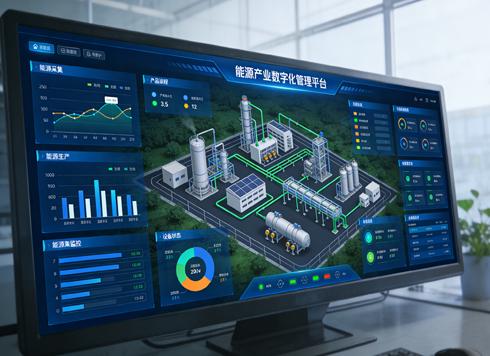
Adopt an integrated design style of "flat + card-based", abandon redundant decorative elements, and take data itself as the core of design. Divide information hierarchies through block-based card layout to present key data centrally, making the interface clean and clear, helping users quickly capture key information, and greatly reducing visual thinking costs.
3. Data Visualization: Infographic Empowerment to Unlock Data Value
Customize diversified infographics and data reports combined with the characteristics of energy business, transforming complex data from scenarios such as petroleum exploration and power production into intuitive and artistic visual expressions. Through accurate data analysis and design presentation, make "cold" data become "warm", not only improving data readability but also making business connotation easier to understand.
4. Experience Upgrading: Breaking Homogenization to Create Elegant B-end Design
Break the inherent cognition of "B-end software prioritizing functions over experience". On the basis of ensuring practicality, create interface design with both professionalism and aesthetics through unified icon styles, exquisite typography hierarchies, and accurate data visualization, realizing the humanized expression of B-end software.
5. Scenario-based Visualization: 3D/2.5D Restoration of the Entire Industrial Chain
For core scenarios such as port coal loading, adopt digital twin or 2.5D illustration technology to reproduce geographical environments and operational processes, realizing macro monitoring of data across the entire industrial chain. It not only supports daily business display and leadership reporting but also enables visual early warning of abnormal events, facilitating intelligent command and dispatch.
6. Risk Early Warning: Real-time Trigger of Anomalies for Closed-loop Management
Combined with technologies such as patrol robots and intelligent cameras, convert equipment abnormal data into hierarchical early warning information, which is intuitively presented in chart form on the homepage. Design the full-process interaction of "alarm reminder - defect review - work order submission" to ensure that risk information is delivered in a timely manner and the processing process is closed-loop and controllable, making safety management more efficient.
7. Icon System: Full-scenario Coverage with Unified and Adaptive Styles
Build an icon system covering multiple types such as brand logos, functional operations, and system prompts, providing diversified style options including flat, linear, and 2.5D. All icons conform to the professional attributes of the energy industry while maintaining a unified design language, meeting both branding and functional needs.
8. Information Architecture: Card-based Design to Reduce Cognitive Load
Strengthen the layering and three-dimensional sense of the page through card-based design, presenting associated information centrally. This not only highlights key data but also makes the interface layout more regular. Such design improves page aesthetics and helps users quickly establish information cognition, significantly enhancing operational efficiency.
9. Motion Guidance: Intuitive Demonstration to Lower Learning Costs
Replace cumbersome text descriptions with motion illustrations to intuitively display interface operation logic and functional processes. Guide user learning through scenario-based operation demonstrations, reducing thinking time and entry difficulty, especially helping new employees quickly familiarize themselves with system operations.
IV. Conclusion
The digital transformation of the energy industry requires not only technical support but also experience empowerment. Our UI design solution, centered on "user-centric and business-oriented", deeply integrates digital technologies with energy scenarios through architecture restructuring, visual optimization, and interaction innovation. It not only solves the current design pain points of software but also builds a long-term reusable design system. In the future, we will continue to deepen our expertise in the energy field, and use more professional design capabilities to help the energy industry achieve intelligent upgrading and efficient operation, jointly building a bright future for the new-type energy system.